One widely shared post, read properly.
"Kill Cancer Naturally", item by item.
In 2016 a son in Bangalore who had just lost his mother to oral cancer wrote down every natural remedy and healer he had come across. The post has been forwarded ever since. This site retells it faithfully, in full, with his own cautions kept in, and adds one short evidence check you can open if you want it. Below it is a printed pamphlet for a herbal remedy, translated line by line. One rule runs through all of it: these things are to be taken alongside chemotherapy and radiation, never instead of them.
What cancer is
Cells that stop obeying the rules
Your body replaces old cells with new ones every day. Cancer begins when damage to a cell's DNA lets it divide without stopping and ignore the signals that tell it to die. The result is a lump or tumour, or in blood cancers, abnormal cells crowding the blood and marrow. If untreated, cancer cells can break away and travel to other organs. That spread is called metastasis, and it is the main reason cancer kills.
There are more than 200 types of cancer, and they behave very differently. A slow prostate cancer and an aggressive pancreatic cancer have almost nothing in common except the name. This is why one food, one herb or one "protocol" can never be a cure for "cancer". Treatment has to match the type, the stage and the person.
Stage matters more than almost anything. Stage 1 means the cancer is small and has not spread. Stage 4 means it has reached distant organs. The gap in survival between those two is enormous, and the thing that moves a person from stage 4 to stage 1 is simply finding it earlier.
A widely shared post, item by item
"Kill Cancer Naturally": everything the post recommends, and what we know about each
In 2016 a man in Bangalore whose mother had just died of oral cancer wrote a blog post listing every natural remedy and healer he had come across while trying to save her. It has been reposted and forwarded ever since, including on the page many readers arrive from. This section goes through all of it, in his order, so you do not have to guess which parts are safe.
PART 1 · WHO IS WRITING, AND WHYA son in Bangalore
The author introduces himself as Rohit Mehrotra of Bangalore. He sets out to collect, in one place, the natural treatments for cancer that he found available in India: village practitioners, home recipes, and the vegetables, fruits and seeds that people told him can control or destroy cancer.
His reason is his mother. Her oral cancer was found in March 2015. She went through surgery, chemotherapy and radiation, and the doctors, he says, had spoken of a very high chance of cure. Within about three months of finishing treatment the cancer was back, and the same doctors told the family that only a miracle could help now. He began searching for alternatives and travelled to healers in villages, but he writes that by then it was too late, and he believes the family was told how serious things were far too late to act. He could not save her. He is publishing what he learned, from his own search and from other patients' families, so that the next family has it earlier than he did.
PART 2 · HIS VIEW OF THE HOSPITALSMoney spent, hope raised, nothing saved
He is bitter about the hospitals, and he does not hide it. In his telling, the family paid a great deal for treatment that failed, and was given confidence that turned out to be false. He wants readers to know that conventional treatment did not work for his mother and that nobody warned them it might not.
PART 3 · HOW HE WANTS THE LIST USEDCheck everything yourself
He is careful to say what the list is not. It is not a prescription and it is not an endorsement. For nearly every entry he says whether he has personal experience, and for most he does not; the information came from other families, often through cancer support groups on Facebook. He asks readers to read the linked references, look up reviews, ask any practitioner for the names of patients they have treated, and make their own enquiries before spending money or travelling.
PART 4 · THE PRACTITIONERSTen healers across six states
This is the first and longest section of his post. He lists seven practitioners in detail and three more briefly: five Ayurvedic vaids, two practitioners of Tibetan medicine, and three with no tradition given, in Chhattisgarh, Himachal Pradesh, Karnataka, Kerala, Madhya Pradesh and West Bengal. Where he knows the fees he gives them, and they are small: ₹100 for ten days of medicine, ₹300 a month for two of them, and about ₹1,500 for a two-month course for another. Several entries carry practical notes such as which days the healer sees patients and how to reach the village.
His honesty about them is the most useful part. For most he says he has no personal experience and is passing on what others reported. For one, his own family's experience was poor and the medicines caused side effects. For another he reports mixed reviews and tells readers to enquire further before going. For a third he points readers to the reviews he found. He says plainly that he recommends none of them.
Here is his list, in his order, with his notes on each. Contact details for the first practitioner are in the pamphlet section; the others' mobile numbers are in the original post.
- Vaidyaraj Hemachandra Manjhi, Chhota Dongar, Narayanpur, Kondagaon district, Chhattisgarh. Fee ₹300 a month. His note: from the feedback he received, this vaid may treat even stage 4 cancer. Contact details are in the pamphlet section.
- Dr Yeshi Dhonden, Tibetan medicine, McLeod Ganj, Dharamsala, Kangra, Himachal Pradesh 176219. About ₹1,500 for two months. His note: no personal experience. Others told him Dr Dhonden may treat stage 4, depending on the patient's health and history. He was physician to the Dalai Lama for about twenty years. Dr Dhonden died in 2019.Facebook page · liveayurved.com · yeshidhonden.com
- Vaidya Narayana Murthy, Narasipur, Anandapura, Shimoga, Karnataka. Fee ₹300 a month. His note: good up to stage 3 according to the feedback he received; stage 4 depends.
- Vellan Vaidya, Thirunelly, Kerala. Fee ₹100 for ten days. His note: no personal experience, but people he met said they were cured with this medicine.
- Vaid Babulal, village Kanhavadi, tehsil Ghoradongri, Betul district, Madhya Pradesh. Fee not known. Sees patients on Tuesdays and Sundays; the queue starts at 8 am and people begin lining up the night before. From Betul go to Ghoradongri (35 km), then on to Kanhavadi (3 km). His note: no personal experience; the information came from a Facebook page, so enquire yourself before going.
- Dr Dorjee Rapten Neshar, Tibetan medicine, at Men-Tsee-Khang (Tibetan Medical and Astro Institute), 295, 5th Main Road, 11th Cross, Mahalaxmi Layout, near Anjaneya Temple, Bangalore 560086. Tel 080 2349 6190, bangalore@men-tsee-khang.org. His note: no personal experience.Interview (Friends of Tibet, PDF)
- Vaid Ram Kishan, grandson of Vaid Jeet Ram, Baba Mod, Chail, Solan district, Himachal Pradesh. Also gives medicine for cancer. His note: no personal experience.The Tribune, 2002 · Facebook page
At this point he inserts a note: he is not claiming these people will cure cancer 100 percent; he is only trying to spread awareness of possible treatments. He then adds three doctors who claim to cure, with a request to read their reviews and ask for references of cured patients first.
- Dr P. Banerji (Prasanta Banerji), Kolkata. He links a consumer-complaints page as the review to read.consumercomplaints.in
- Dr Radheshyam. His own experience was not very good; the medicines can have side effects. Enquire more at your own level.
- Dr Pankaj Bhatnagar. Mixed reviews from different people, positive and negative. Enquire further before going for treatment.
PART 5 · THE FOODS AND SUBSTANCESTwenty-four things he was told fight cancer
His second section is a bare numbered list with no introduction. Each entry is a name, a claim, and one or two links to an article that makes the claim. Here is each one, in his order, with the claim as he presents it, his own caveat where he gives one, and the references exactly as he listed them.
- Turmeric may help against cancer, including bowel cancer.Cancer Research UK · The Truth About Cancer · Natural News
- Cow urine can cure cancer.Times of India
- Carrot juice is tied to recoveries from stage 4 cancer.Natural Society
- Beetroot juice acts against cancer.NaturalHealth365 · Chris Beat Cancer
- Pineapple juice contains an enzyme that fights cancer; he links a newspaper story of a woman who ate three pineapples a day.Underground Health Reporter · Daily Mail
- Pomegranate juice affects cancer cells and helps prevent cancer.Natural News · The Globe and Mail
- Custard apple is a "super fruit" with anti-cancer value.PreventDisease.com
- Avocado has anti-cancer benefits.Mercola
- Broccoli is a cancer-fighting vegetable.Cancer Research UK blog · Anti-cancer vegetables study (PDF)
- Spinach lowers the risk of ovarian and prostate cancer.Natural Society · Anti-cancer vegetables study (PDF)
- Ginger kills cancer cells more strongly than chemotherapy does.David Wolfe
- Garlic is a cancer treatment.Livestrong · Anti-cancer vegetables study (PDF)
- Green onion acts against cancer.Anti-cancer vegetables study (PDF)
- Red kidney beans (rajma) protect against cancer.Health Benefits Times
- Potato acts against cancer.Anti-cancer vegetables study (PDF)
- Tomato acts against cancer.Anti-cancer vegetables study (PDF)
- Apricot kernels are a possible remedy. His caveat: he has no experience of them; study them further or take a doctor's advice before using.The Truth About Cancer
- Cashew is beneficial against cancer.Chris Beat Cancer
- Walnut is beneficial against cancer.Chris Beat Cancer
- Almonds are beneficial against cancer.Chris Beat Cancer
- Soursop is said by people he met to kill cancer 10,000 times faster than chemotherapy. His caveat: no personal experience; study it before using. He gives no reference for this one.
- Seeded grapes may stop cancer cells.WebMD
- Cannabis oil (bhaang ka tel) helps against cancer. His caveat: it is illegal in some countries, so check the law where you live.Firstpost · Dainik Bhaskar
- Wheatgrass is among the remedies; he points to articles describing its uses.Organic Authority · WebMD
PART 6 · HOW HE CLOSESNot a doctor, not a promise, but do not give up
Before the disclaimer he asks readers to go through the references and do their own research before following anything above, and he gives an email address and a mobile number for anyone who wants more information. Those are in the original post; we do not reprint personal contact details. He ends with a disclaimer that is more honest than most of the forwards built from his post. He is not a doctor. He is not claiming that any of these treatments will cure cancer. He is not recommending any of the practitioners. He asks readers once more to go through the references and research for themselves before acting on anything. And he asks them not to lose hope.
Our item-by-item check of the 24 what the evidence says about each, with a verdict
| Item | What the post says | What the evidence says | Verdict |
|---|---|---|---|
| Turmerichaldi | May help against cancer, including bowel cancer. | Curcumin does interesting things to cancer cells in a dish and has been through dozens of small human trials. None has shown it shrinks an existing cancer, largely because the body absorbs almost none of it. As a spice it is good food and harmless. | Good food |
| Cow urinegomutra | Can cure cancer. | No human trial exists. The lab work was on cell lines and mice, and the much-cited patent was for a drug "enhancer", not a treatment. | No evidence |
| Carrot juice | Linked to recovery in stage 4 cases. | The stage 4 stories trace back to one or two individuals writing about themselves, at least one of whom had also had surgery. There is no trial. Carrots are good food; very large daily amounts turn the skin orange and nothing else. | Good food |
| Beetroot juice | Anti-cancer. | The pigment betanin affects cancer cells in a dish. There is no human cancer trial. Fine as food. | Good food |
| Pineapple juice | Contains an enzyme that fights cancer; a woman ate three a day and recovered. | Bromelain has lab and animal data only. The newspaper story is a single anecdote about a patient who was also under medical care. Three pineapples a day will burn your mouth; one is a fine dessert. | Good food |
| Pomegranate juiceanar | Affects cancer cells and helps prevent cancer. | One small early study suggested it slowed a blood marker in prostate cancer. A larger placebo-controlled trial found no effect. Good food. | Good food |
| Custard applesitaphal | A "super fruit" with anti-cancer value. | Same plant family as soursop, same story: lab studies only. Eat it because it is delicious, not as medicine. | Good food |
| Avocado | Anti-cancer benefits. | A compound in avocado affected leukaemia cells in a dish in one 2015 study. No human data. Good food. | Good food |
| Broccoli | A cancer-fighting vegetable. | People who eat more cruciferous vegetables have somewhat lower rates of some cancers over a lifetime. That is prevention by diet, which is real. There is no evidence it treats a cancer that already exists. | Good food |
| Spinachpalak | Reduces ovarian and prostate cancer risk. | Same as broccoli: a leafy-vegetable-rich diet is associated with lower risk. Not a treatment. | Good food |
| Gingeradrak | Kills cancer cells more strongly than chemotherapy. | The "stronger than chemo" claim is from one dish study of a ginger compound on breast cancer stem cells. In humans, ginger has decent evidence for one thing: easing chemotherapy nausea. That is worth using. It is not a treatment for the cancer. | Symptoms |
| Garliclahsun | A cancer treatment. | Population studies link garlic-rich diets to lower stomach and bowel cancer rates. No trial shows it treats cancer. Good food; high-dose supplements can thin the blood before surgery. | Good food |
| Green onion | Anti-cancer. | Same allium family as garlic, same evidence: a healthy diet ingredient, not a treatment. | Good food |
| Kidney beansrajma | Health-promoting against cancer. | Fibre-rich pulses lower bowel cancer risk over a lifetime. Must be fully cooked; raw or undercooked rajma causes severe vomiting. | Good food |
| Potato | Anti-cancer. | No evidence either way. It is a potato. | Good food |
| Tomato | Anti-cancer. | Lycopene has mixed evidence for slightly lower prostate cancer risk. Nothing on treatment. Good food. | Good food |
| Apricot kernelsvitamin B17, laetrile | A possible remedy; the author says to study it or ask a doctor first. | The author's caution was right. Amygdalin breaks down into cyanide. Clinical trials found no benefit, and there are documented poisonings and deaths. Do not take this. | Dangerous |
| Cashew | Beneficial against cancer. | Nut eaters have slightly lower overall mortality in large studies. No treatment evidence. Good food. | Good food |
| Walnutakhrot | Beneficial against cancer. | One observational study of bowel cancer survivors found nut eaters did better. Promising for diet, not a treatment. | Good food |
| Almondsbadam | Beneficial against cancer. | As for other nuts. Good food. | Good food |
| Soursopgraviola, laxman phal | People say it kills cancer far faster than chemotherapy; the author says to study it first. | No human trial, ever. The "10,000 times" figure is from a dish. Regular high doses are linked to nerve damage in Caribbean studies. | No evidence |
| Seeded grapes | May stop cancer cells. | Grape seed extract affects cells in a dish. No human cancer trial. Eat grapes. | Good food |
| Cannabis oilbhaang ka tel | A cancer aid; check local laws. | Cannabis medicines help some patients with nausea, appetite and pain. No human evidence that it shrinks tumours. Cannabis oil is illegal under India's NDPS Act, and street oils have unknown strength and purity. | Symptoms |
| Wheatgrass | Listed among remedies. | One small Israeli study found wheatgrass juice reduced some chemotherapy side effects in breast cancer patients. That is the strongest evidence on this whole list, and it is about side effects, not the cancer. Raw juice must be hygienically prepared for anyone with low immunity. | Symptoms |
About the ten practitioners
The post gives names, villages, phone numbers and fees for ten healers. The names, places, fees and public links are reproduced above in Part 4, and the first practitioner's contact details are in the pamphlet section; the others' mobile numbers are not reprinted. The author himself says he has no personal experience with most of them and is passing on what others told him. For one he reports that his own family's experience was poor and that the medicines caused side effects. For another he notes mixed reviews.
That is not a reason to insult traditional medicine, which has a real place in symptom relief and wellbeing. It is a reason to apply the same test to a vaid as to a hospital: what happened to the last hundred patients with your cancer, and can you speak to them? A practitioner who treats cancer and cannot answer that should not be treating cancer. If you do consult one, tell your oncologist what you are taking, because some herbal preparations interfere with chemotherapy drugs and some contain heavy metals.
What to take from the post
Almost everything on the list is good food. Eat it. A diet built on vegetables, fruit, pulses, nuts and spices is one of the few things that genuinely lowers your lifetime cancer risk, and it helps you stay strong through treatment. The author was not wrong to want his mother to eat well.
Nothing on the list treats an existing cancer. Three items can hurt you: apricot kernels, high-dose soursop, and unregulated cannabis oil. Two, ginger and wheatgrass, have modest evidence for easing chemotherapy side effects, which is a real benefit worth having alongside treatment.
The most important line in the post is the one the forwards leave out: the author does not claim any of this cures cancer. Honour the family's loss by taking that line as seriously as the list.
A printed pamphlet, as handed to patients
"Suraksha Jangli Buti": a forest-herb remedy, and what its pamphlet promises
In the villages of Bastar in Chhattisgarh, the same idea as the post above arrives on paper. This pamphlet, printed in Hindi and handed out in 2026, advertises a single preparation made from wild forest herbs. Its name, Suraksha Jangli Buti, means "protective wild herb". The sheet makes three things clear: the list of illnesses the vaid says the herb can treat, the foods a patient must give up while taking it, and how to reach him. The first two are translated below, in plain English and grouped so they are easier to take in. The third is in the contact box further down.
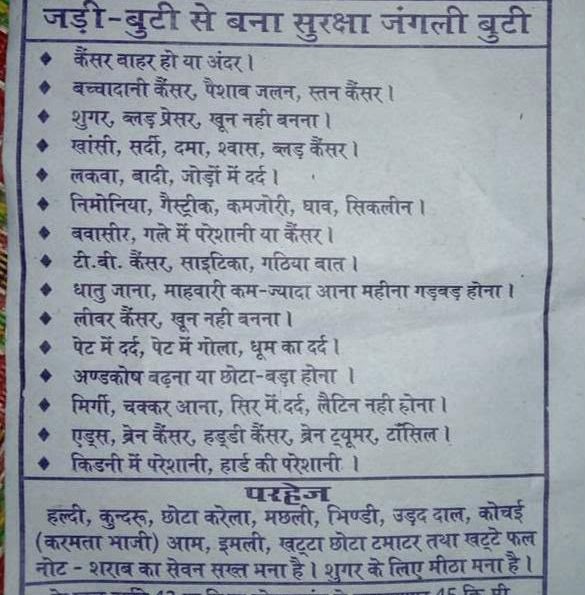
The pamphlet as received. The heading reads "Jadi-buti se bana Suraksha Jangli Buti": a protective wild herb made from medicinal plants. The practitioner's name and phone numbers are cropped from the image and printed in the contact box below.
What the vaid says the herb treats
One preparation, around forty conditions
The pamphlet lists them in fifteen lines with no grouping. Here they are sorted by the part of the body they concern, so a reader can see at a glance whether their own condition is named.
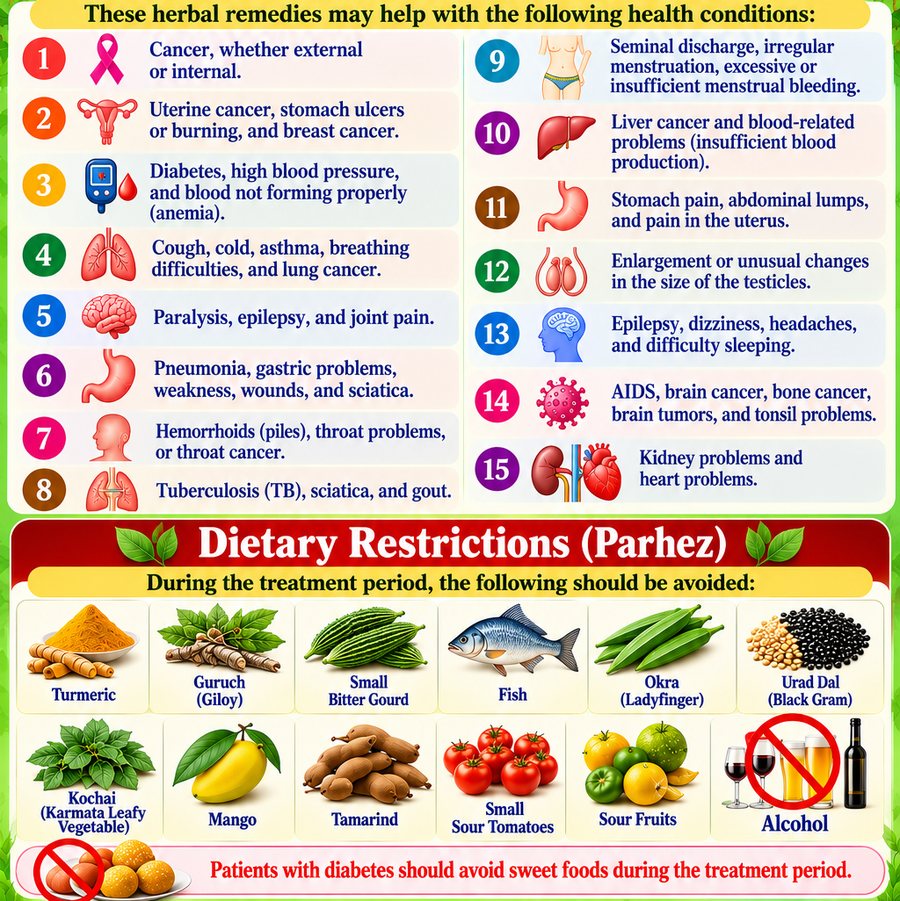
- Cancers. Cancer "whether on the outside of the body or inside"; cancers of the uterus, breast, blood, throat, liver, bone and brain; brain tumours. This is the pamphlet's first line and its main promise, which is why it is on this site.
- Blood and sugar. Diabetes, high blood pressure, sickle cell disease, and "blood not forming", the village phrase for anaemia.
- Chest and breathing. Cough, cold, asthma, difficulty breathing, pneumonia, tuberculosis, and tonsil trouble.
- Stomach and bowels. Gas and bloating, gastric trouble, stomach pain, a lump felt in the abdomen, piles, and constipation.
- Nerves, head and joints. Paralysis, epilepsy, dizziness, headache, joint pain, sciatica, and rheumatism.
- Women's and men's health. Burning on passing urine, periods that are too heavy, too light or irregular, semen loss, and swelling or change in the size of the testicles.
- Everything else. Weakness, slow-healing wounds, AIDS, kidney trouble and heart trouble.
Parhez: the foods the patient must give up
Like most village vaids, this one prescribes a parhez, a list of foods to avoid for as long as the medicine is being taken, on the belief that they work against the herb or feed the illness. Here the patient must give up turmeric, kundru (ivy gourd), small bitter gourd, fish, okra, urad dal, kochai (taro, called karmata bhaji locally), mango, tamarind, small sour tomatoes and all sour fruit. Alcohol is strictly forbidden. A diabetic patient must also give up sweets, which is the one instruction on the sheet any doctor would agree with.
One thing worth noticing: turmeric is on this avoid list, while the post above counts it as an anti-cancer food. The two sources disagree. If you consult this vaid, follow his parhez; either way, tell your oncologist exactly what you are taking and what you have stopped eating, because some of these restrictions matter during chemotherapy.
That is the whole pamphlet. It names the herb, lists what it is for, sets the diet, and gives a phone number. It does not say what the herb is made of, how much to take, for how long, what it costs, or what happened to the patients who took it. Nothing on it has been tested in people. If you decide to try it, take it alongside the chemotherapy, radiation or surgery your oncologist prescribes, never in place of them. Only then can it help.
Contact details, as printed on the pamphlet and posters
Maharaj Shri Vaidyaraj Hemchand Manjhi Bairaj
- Village: Chhotel Dongar (also written Chhota Dongar), District Narayanpur, Chhattisgarh, India
- Mobile: 94791 14226, 94079 54317
- Location: about 45 km from Narayanpur via National Highway 43 towards Kondagaon; Chhotel Dongar is 43 km from Narayanpur
- Fee, as given in the post above: ₹300 for one month of medicine
These details are reproduced exactly as the practitioner printed them for the public. They are not verified by this website, may be out of date, and are not a recommendation. Anyone with a cancer diagnosis should be under the care of an oncologist, whatever else they choose to try. If you take this remedy, take it alongside your chemotherapy and radiation, not in place of them, and tell your oncologist. Only then can it help.
The same pamphlet, as posters
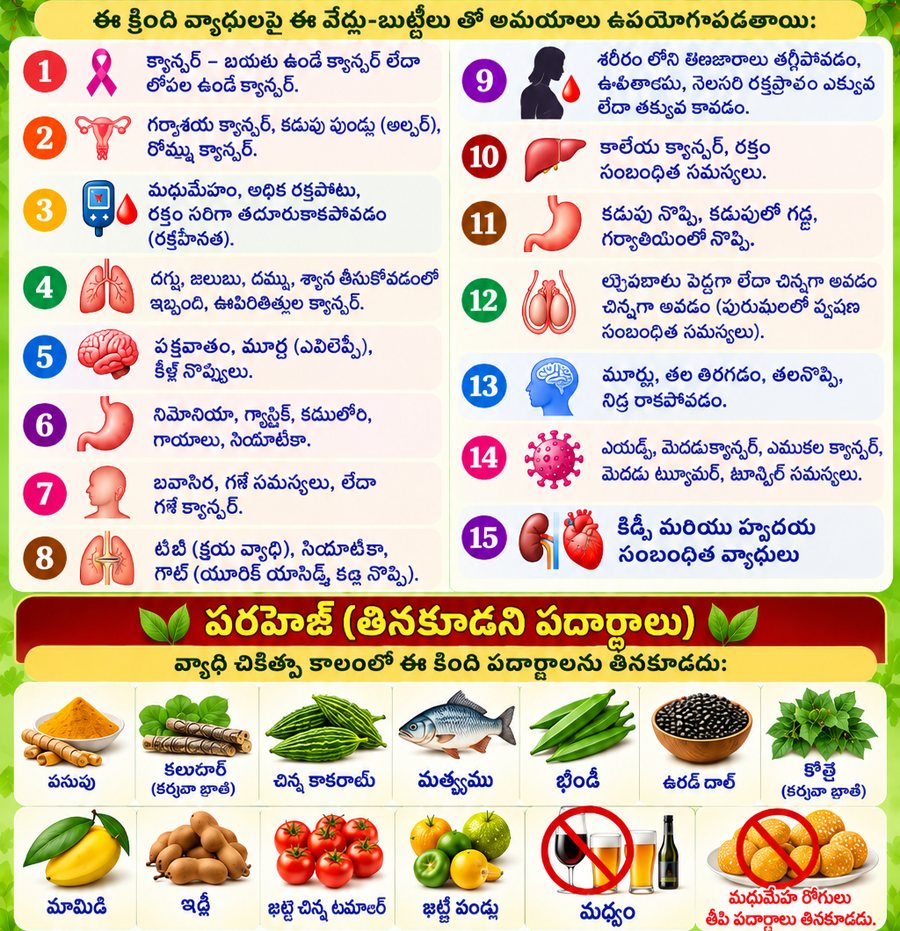
English and Telugu versions of the illness list and restrictions
The same content redrawn as illustrated posters. The practitioner's name, photograph, phone numbers and directions are cropped from the images; they are printed in the contact box above.
Questions people ask
Before you act on anything here
Can I take these remedies during chemotherapy or radiation?
That is the only way this site suggests using them: alongside the treatment your oncologist has prescribed, never instead of it. Tell the oncology team everything you take, because some herbs and high-dose supplements interfere with chemotherapy drugs and radiation. Ordinary foods on the list, such as vegetables, fruit, pulses and nuts, are fine to eat.
Does anything on this site cure cancer?
No. The post's author says so himself, and the pamphlet offers no evidence. Nothing listed here has been shown in human trials to shrink a tumour. Some items may help with strength, appetite or side effects while you are being treated. That is support, not a cure.
Which items on the list can actually be harmful?
Three stand out: apricot kernels (they release cyanide and have caused poisonings), high doses of soursop (linked to nerve damage), and unregulated cannabis oil (unknown strength, and illegal in India). Raw kidney beans must be fully cooked. Everything else on the list is food.
How do I contact the Vaidyaraj in the pamphlet?
His name, village, phone numbers and directions are in the contact box in the pamphlet section, exactly as he printed them. This site has not verified them and does not recommend him. Ask him what happened to the last patients he treated for your cancer, and keep your hospital appointments while you decide.
Is the information on this site from the website owner?
No. The post section is a faithful retelling of a 2016 blog post by a son who lost his mother. The pamphlet section reproduces a practitioner's own printed claims. The only words that are ours are the evidence check, the notes marked as ours, and the rule that runs through the site: alongside treatment, never instead.
I want to ask about wellness supplements. Where do I write?
Use the Contact page. Read the note there first: supplements are discussed as general wellbeing products to be taken alongside chemotherapy and radiation, with your oncologist's knowledge, never as a treatment for cancer.